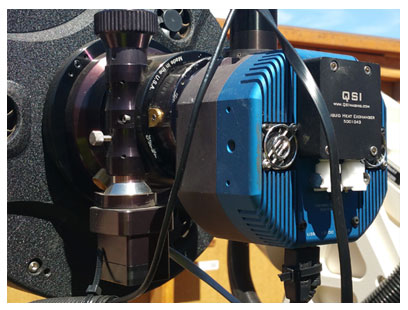
When I started photography of the night time sky back in the early 70’s I was interested in these faint objects in the Sharpless Catalog. Back then I was using a film called 103AE with worked well but was grainy. Switching to hyper 2415 got rid of the grain in the film was not quite a sensitive. However, with ether film, most of the objects in the catalog did not even show up.
That all changed when the CCD Camera became available and grew in popularly in the late 1990’s. The CCD Camera goes beyond the limits of what film did making it possible to capture these mysterious objects. The introduction of hydrogen-alpha filters opened the door giving me the ability to image these once uncommon objects that were difficult to shoot. Since the catalog was focused on nebula with strong hydrogen, this filter did wonders.
The gallery is designed to select criteria that help you find the Sharpless objects you are interesting in. I also have information on how I processed my images. There are also screen savers and Windows wallpaper that is free to download.
All images on my web site where taken by me using a number of different telescopes and cameras. I have always used AstroDon filters for color and narrowband imaging. They seen to produce the least about of halos and yield a good color balance in the RGB. Most images were captured in my backyard observatory but now captured at the San Pedro Valley Observatory in Benson, AZ.
Stewart Sharpless of the U.S. Naval Observatory published his catalog of 313 HII regions and the catalog is comprehensive north of declination -27 degrees using the Palomar Sky Survey plates in 1959. (south of declination -27, the coverage is only partial)
An H II region is a cloud of glowing gas and plasma, sometimes several hundred light-years across, in which star formation is taking place. Young, hot, blue stars which have formed from the gas emit copious amounts of ultraviolet light, ionizing the nebula surrounding them. H II regions may give birth to thousands of stars over a period of several million years.
In the end, supernova explosions and strong stellar winds from the most massive stars in the resulting star cluster will disperse the gases of the H II region, leaving behind a cluster such as the Pleiades. H II regions are named for the large amount of ionised atomic hydrogen they contain, referred to as H II by astronomers (H I region being neutral atomic hydrogen, and H2 being molecular hydrogen). H II regions can be seen out to considerable distances in the universe, and the study of extragalactic H II regions is important in determining the distance and chemical composition of other galaxies.
Many famous objects are imaged by amateur astronomers who are unaware that they are part of the Sharpless (SH2) catalog. The great Orion nebula, also known as Sh2-281, and the commonly imaged Flame nebula, known as SH2-277, are some of the December favorites. Six months later in the month of June, SH2-25, which is also known as The Lagoon nebula and the North American Nebula listed in the catalog as SH2-117, are in the sky.
Some of the objects that Sharpless includes are not HII nebulae at all; instead they are reflected star light off a galactic dust cloud above and below our own galaxy. This is known as Integrated Flux Nebulae which Steve Mandel (www.galaxyimages.com) is cataloging in his Unexplored Nebulae Project. There are a few Sharpless catalog numbers that fall into this, the largest labeled Sh2-178 near the North Star Polaris.
Other Web Sites
Galaxy Map
This website presents a face-on map of much of the Milky Way, including the distances and positions of more than 8 thousand bright stars, star clusters, nebulae and giant molecular clouds. The location of each object on the galaxy map is based on the scientific literature.
The SuperCOSMOS Explorer by Kevin Jardine of GalaxyMap
He has added the SuperCOSMOS explorer to the Introduction to the Milky Way Explorer. This shows
hydrogen-alpha images of the southern galactic plane (30° > l > 210°). As he explains in the
Introduction to the Milky Way Explorer, the SuperCOSMOS data is not calibrated and there are
some obvious plate transitions. Nevertheless, he thinks that these images are very useful and
show details of some large faint nebulae that he has never seen before.
More information: http://galaxymap.org/drupal/node/127
The Sharpless Observering Catalog by Reiner Vogel, Freiburg, Germany
You can also join in at the Yahoo Sharpless Catalog Imagers Group
Astronomy Online Readers Gallery
Welcome to Astronomy magazine's Online Reader Gallery — a collection of spectacular images from astrophotographers around the world.
CCD Commander
CCD Imaging Automation
San Pedro Valley Observatory
The well-known Astronomers Inn (formerly The Skywatchers Inn) on the east side of Benson has reopened as the San Pedro Valley Observatory (SPVO). It is the site of the old Vega-Bray Observatory containing the wonderful 20-inch Maksutov, one of the largest telescopes of its kind in the US. Eventually plans to have remotely controlled telescopes for those who want to observe from their homes. For those on vacation, telescopes and host astronomers available for hire to give sky tours.
Images can be used in books, magazines, or any other published paper that deals with astronomy. However, please send me an e-mail and give me the credit as listed below:
Image by Dean Salman - http://www.sharplesscatalog.com
|
I have put together a collection of images in BMP format that can be used for
Windows wallpaper. The images are 1200x1000 but can be resized to fit your desktop if you have
some kind of image software. These are free to download and I will be posting more over time.
The screensavers is a self installed application that installs your screensaver. The installation should work ok
for any Windows versions that are XP or greater.
The screensavers and wallpapers are freeware and not to be sold anywhere.
|
|
|
Select the ScreenSaver to Download.
To send me e-mail, fill out the form below: